
September '23
The dark web, societal norms, and chasing comets

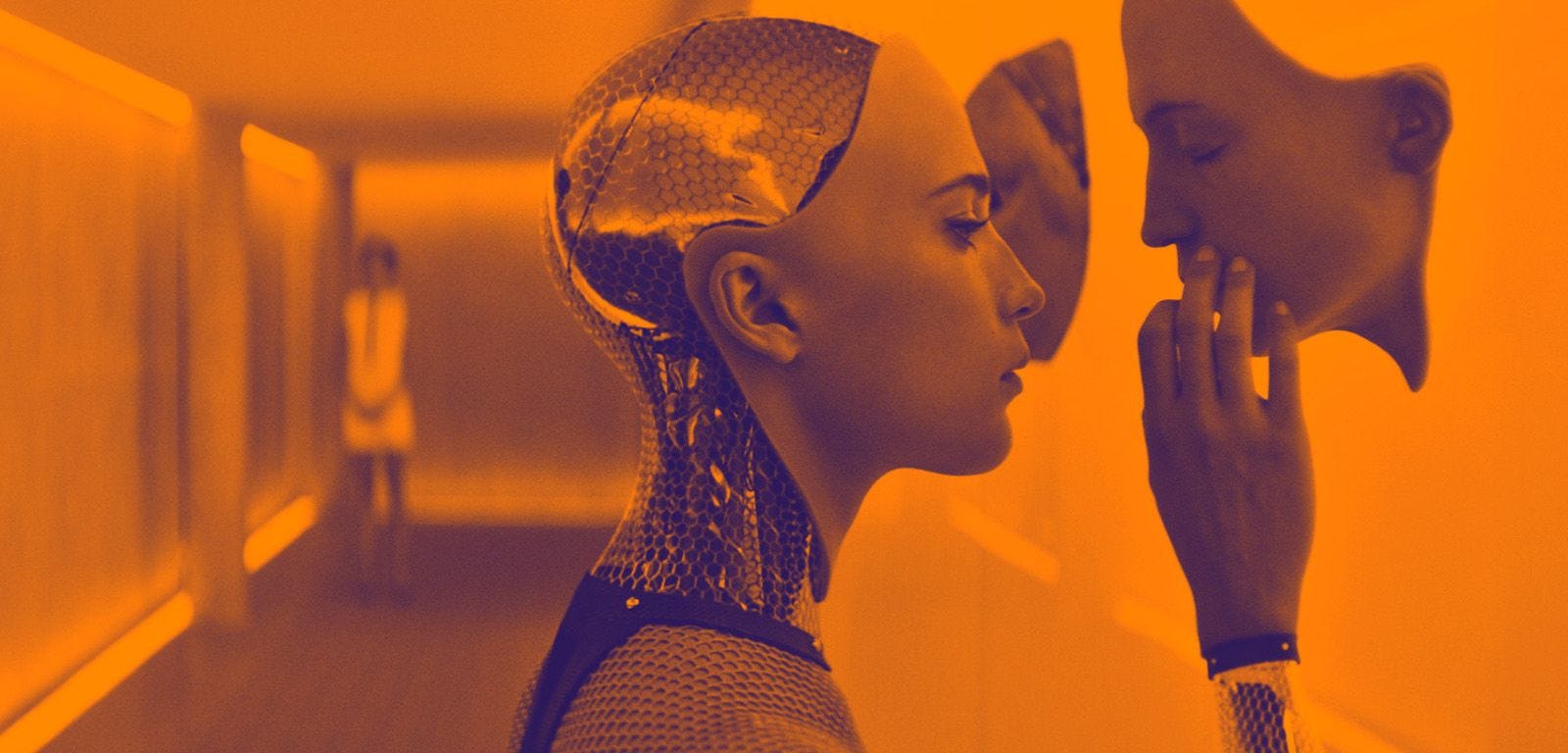
Scene from the film ‘Ex Machina’
Creative Riff
This was formerly a “news” segment, but in all honesty, it was the only segment I disliked writing. I don’t really care nor follow the news. So instead, gonna try something different this month and see if it resonates with folks (you may get a text asking for feedback :P)
## Chasing Comets ##

In the days before recorded time, our ancestors lived the land with bow and spear. Made fires in the hills and whispered stories with faces aglow the dying embers. At night we'd lay in deep furs on pine thicketed forest ground and stare at the starblown sky. Counting blinking stars and ascribing meaning to their shape while conversing with them in deft whisper and posing questions of the soul.

And when the stars would fall from the heavens men would chase them. With bared feet and stooped shoulder they'd rush over the hills tracking the course of the fallen rock and stumble upon its resting place deep in the glens of the mountain. The smoldering stone gleamed with emerald and sapphire iridescence and hummed with mystery which not be of this world nor any other. Placing hand on stone they'd stare deep into the heart of the comet and ponder the spinning planets and the course whence the meteorite had come to pass and raise eyes skywards in contemplation of the cosmos.

Align the sextant. Set a heading. Draw a footpath amongst the celestial vault.
Ideas
The Dark Web
The “dark web” is so often associated with nefarious activity that I think it gets a bad rap. Yes, there are sites where you can seemingly purchase guns, drugs, etc. But there is also a wealth of content that is perfectly legal and simply exists on the dark web because its too “edgy” for the public internet (which is often referred to as the “Clearnet”). For example, The New York Times actually maintains a dark web presence and WikiLeaks has been the platform that has enabled dozens (if not more) national security leaks. And this brings us to the heart of the what the “dark web” was originally intended to be. It was designed to be a means to conduct activity online with complete anonymity. Whether that be entering honeypots, red rooms, illegal marketplaces, or leaking national security documents to the American public.
And now, there has been increased speculation that the Feds have taken over “nodes” (aka servers) that undergird the dark web with the likely intent of being able to de-anonymize users based on their IP address. Thats not to say that catching criminals is a bad thing, but it completely undermines your ability as a user to navigate online with anonymity. Anyways, if you’re interested, this breakdown by Mental Outlaw over on YouTube is superb:
The Ascent of Money
A year or two ago I read a book called The Ascent of Money by Niall Ferguson where he takes a stroll through the historical advent of currency.
In the book, he argues that the creation of ‘credit’ by banks was the first great revolution in the “ascent of money”. By allowing individuals — or any enterprise for that matter — the ability to borrow more money than they currently have on hand allowed for an exponential growth in the worldwide economy. And this can be relatively easy to visualize. Imagine you are a small farmer in the hills of Italy during the 1400s. By reaping your harvest each fall you are able to afford the basic necessities for your family. But what if your son wants to join the family trade whence old enough? What if he has a family of his own? You don’t have enough money per your modest harvest to afford buying another plot of land for your son…so you go to the bank. And at the fixed interest rate provided by the bank, you suddenly have the ability to further your family’s enterprise which in turn expands the GDP of your community and nation writ-large.
Ferguson then goes on to argue that the birth of the bond was the second great revolution in the “ascent of money”. Bonds effectively present a means of borrowing from a broader range of people or institutions than just banks. When a country issues trillions of dollars in bonds to pay for some governmental program this is effectively borrowing money from some nation(s) and inherently its citizens. This leads us to the exact reason why bond markets have such a momentous influence on the global economy:
When bond prices fall, this is seen as: "those who lent us money don't believe we are going to pay it back"
Likewise when bond prices rise, its viewed as: "this nation and its economy look like a promising investment"
So you can think of bonds as ‘stocks’ for nations.
Now that we have this understanding of how bonds work, lets consider the scenario where bond prices fall. How do you think interest rates would respond?
Actually, let me re-phrase the question.
Imagine everyone in the world decides “the United States economy is in turmoil and there is no way they can afford to pay back their debt”. Do you think that will make borrowing money from the bank more or less expensive for you, a US citizen? More expensive obviously. The world predicts a forthcoming depression, so the bank is hesitant to lend you money because you might not be able to pay it back. Therefore, they jack up the interest rate to account for this risk when lending you money.
TL;DR — The ability to borrow money from banks evolved into institutions being able to borrow from you (the people) via bonds; and that dynamic has gross ramifications on the worldwide economy.
Examining the Outskirts of Society
Most of us live cyclical lives. Thereby a routine. Whence established the bounds of your social circle are neatly defined. And you go through a week or a year and so very seldom meet someone new.
Now let’s consider the citizens of this country existing on the outmost fringes of society. Heroin addicts. Self sufficient farmers out in no-where Wyoming. The men working the night shift sweeping the inner-city streets. Who are these people? How did they come to be here? What drove such a deviation from the norm?
A day in the life of a heroin addict is so far different than that on my own that I wouldn’t know where to start if given the option to swap shoes. Where do you meet the dealer? How much is an ounce? Where does one shoot up? Sounds stressful to be honest. And if growing potatoes and fetching water from a stream because we have no electricity in the mountains of Wyoming? That sounds even more unreal.
I like to think about the lives of these sorts of people because it often makes me question my own circumstances. My own daily habituations.
Did I fall for “this trap”? Am I following a presupposed narrative? What’s out there to experience? How much of ‘wrong’ is really ‘bad’? Who determines ‘bad’? I never got a chance to vote by the way. Times have changed and I’m not sure I fully agree.
Some Literature
She laughs and looks out the window and I think for a minute that she's going to start to cry. I'm standing by the door and I look over at the Elvis Costello poster, at his eyes, watching her, watching us, and I try to get her away from it, so I tell her to come over here, sit down, and she thinks I want to hug her or something and she comes over to me and puts her arms around my back and says something like 'I think we've all lost some sort of feeling'.

- Bret Easton Ellis (Less Than Zero)
Thanks for reading my Substack! Feel free to share if you’d like.
Link to this post: https://aidanjude.substack.com/p/september