
November '23
Human evolution in a digital world

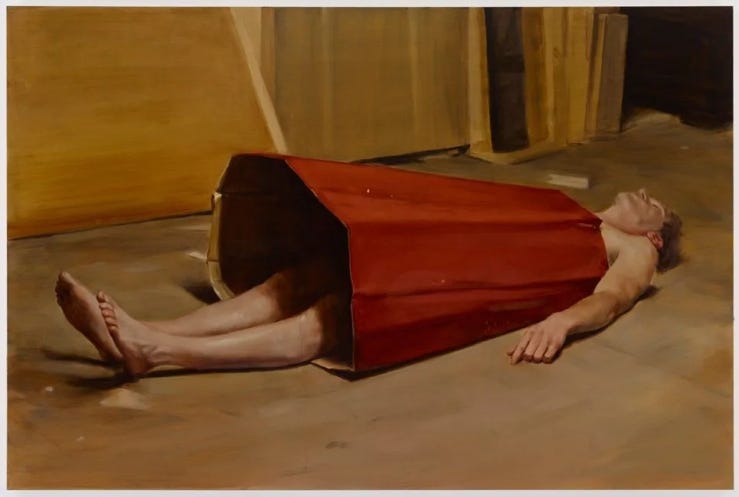
The Devil’s Dress, 2011 by Michaël Borremans (b. 1963)
Ideas
Just one essay this month.
Human Evolution in a Digital World
The digitation of society is a relatively modern phenomenon. The culmination of information ranging from hieroglyphics carved in stone to newspapers delivered to your doorstep spanning centuries. Then arose a new era — that of mass marketability and rung forth in varying sound, visual, and written modes — a digital one.
For millennia we as humans formed small, tight-knit communities. We interacted with our immediate family, neighbors, and townspeople on a daily level and by oral expression almost entirely. Then the rise of the written word and thousands of years of its thereby evolution. From runes in stone, to painted scrolls, and ultimately the mass production of newspapers. And while the evolution of written communication fundamentally changed human interaction writ-large, this progression took place over thousands of years. Now fast forward to the 20th century and its foundational technologies.
[1910s] The telephone becomes an ordinary household commodity
One-to-one human communication over long distance becomes instant and retains a distinct human element — your voice.
Does this strengthen our communal ties? Or degrade them?
[1920s] Radio broadcasting goes commercial
One-to-one human interaction and impersonal written word is surpassed by a widely available verbal transmission. The world’s happenings accessible with the turn of a knob.
[1950s] Television surpasses radio as the most popular broadcast medium
Radio programming’s shortcomings now forgone with a mode that can sustain your attention with it’s vocal and visual medium. Human communication attaining new heights and entertainment its freshly cemented cornerstone.
[1990s] The rise of the world wide web
You can now search for anything or anyone on the Internet.
Are we as humans more or less intelligent now that we have access to the world’s information with the click of a button? To what degree did human “connectedness” fundamentally change during this time frame? Was it for the better?
[2000s] Cell phones are now commonplace
The digital world is now portable. You take it with you everywhere you go. Our daily lives are now interrupted by texts, calls, and Fantasy Football notifications.
[2010s] Social media becomes a worldwide cultural institution
Feeds, trends, and influencers have come to dominate our modern culture. Some people shy away from these platforms entirely while others embrace them and make millions. Does one approach hold a higher moral ground than another?
[2020s] ML and AI remain poised to disrupt in nearly every industry
A bold future? Or brave new world?
We just walked through ~100 years. Try and wrap your head around that.
For thousands of years we either spoke or wrote our thoughts down. Now we record, live-stream, crop, and filter. Then upload, like, and share.
If Darwin and evolutionary biology are any indication to the human condition, then we as animals are built to adapt. It’s why we have opposable thumbs. But that same inherent evolutionary tendency has been scientifically proven to span hundreds (if not thousands) of years. How long did we crawl around on all fours before reaching the point where we could stroll on two? It almost feels like modern society and our technology is advancing too rapidly — and our innate human programming is still hardwired to an era long since past. Maybe the Internet, and smart phones, and social media don’t make sense to us because they’re not supposed to.
I sure as hell don’t know what to make of this day and age. But I’d like to get better at living in it. Maybe you and I could do it together?
Some Literature
The sea had jeeringly kept his finite body up, but drowned the infinite of his soul. Not drowned entirely, though. Rather carried down alive to wondrous depths, where strange shapes of the unwarped primal world glided to and fro before his passive eyes; and the miser-merman, Wisdom, revealed his hoarded heaps; and among the joyous, heartless, ever-juvenile eternities, Pip saw the multitudinous, God-omnipresent, coral insects, that out of the firmament of waters heaved the colossal orbs. He saw God’s foot upon the treadle of the loom, and spoke it; and therefore his shipmates called him mad. So man’s insanity is heaven’s sense; and wandering from all mortal reason, man comes at last to that celestial thought, which, to reason, is absurd and frantic; and weal or woe, feels then uncompromised, indifferent as his God.

- Herman Melville (Moby Dick)
Thanks for reading my Substack! Feel free to share if you’d like.
Link to this post: https://aidanjude.substack.com/p/november