
STUDY GUIDE | Quantum Gravity

A star.
Take one twenty times the Sun’s mass — and everything in this first stretch is layer one, as tested as physics gets.
For millions of years the star is a standoff: gravity crushing inward, fusion pushing out.
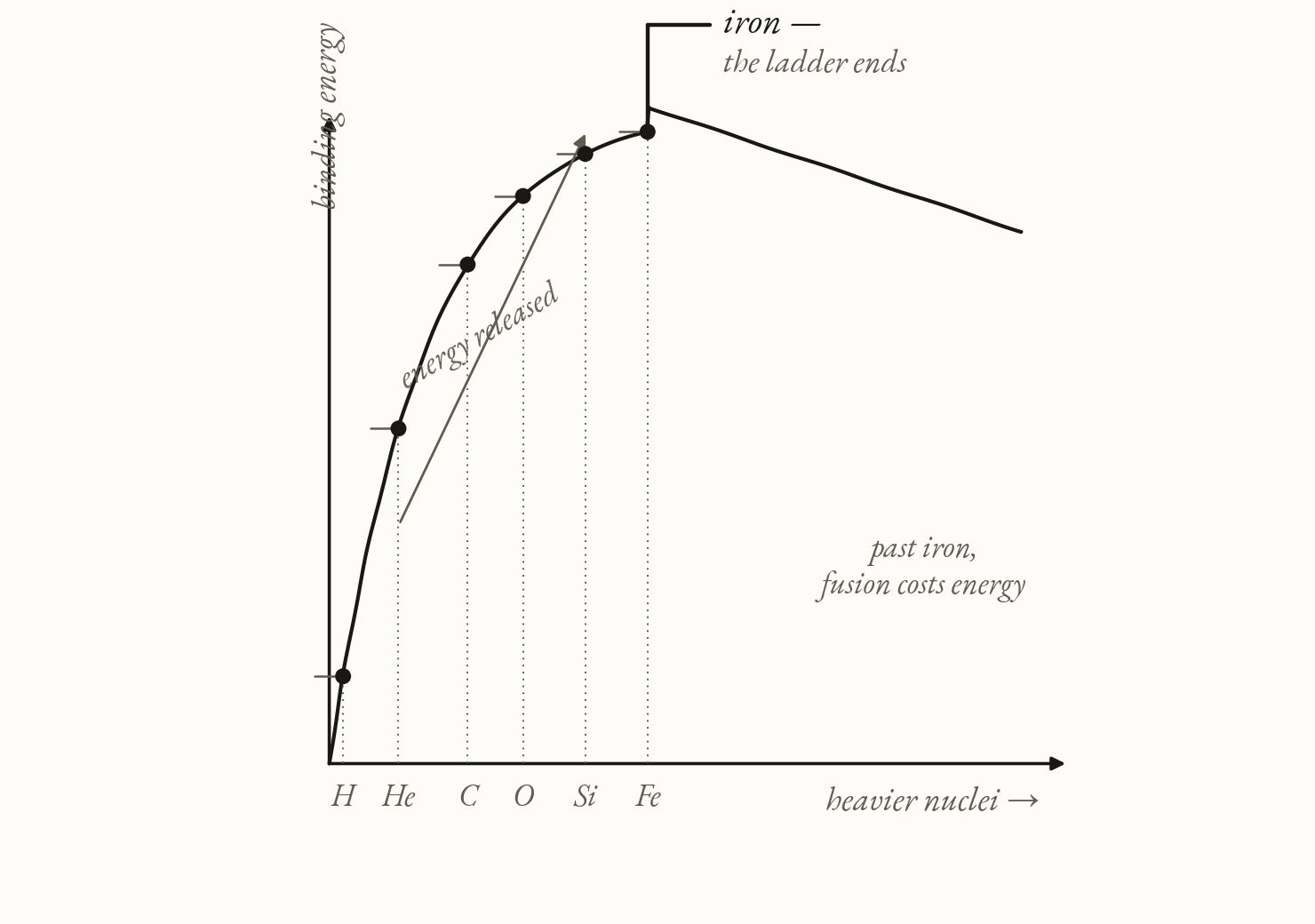
But fusion is a ladder that ends at iron — fusing iron costs energy — so when the core turns to iron, the furnace shuts off mid-fight. The core collapses at a quarter the speed of light. And here’s the part most people miss: what catches it first is quantum mechanics. Electrons, then neutrons, refuse to be squeezed into the same state (the Pauli exclusion principle). That refusal is an outward pressure with no heat behind it — pure quantum stubbornness. Neutron stars are balls the size of a city where QM is literally holding gravity off.
But there’s a ceiling — roughly three solar masses — above which no known quantum pressure can win. Past it, general relativity says something remarkable: collapse becomes compulsory.
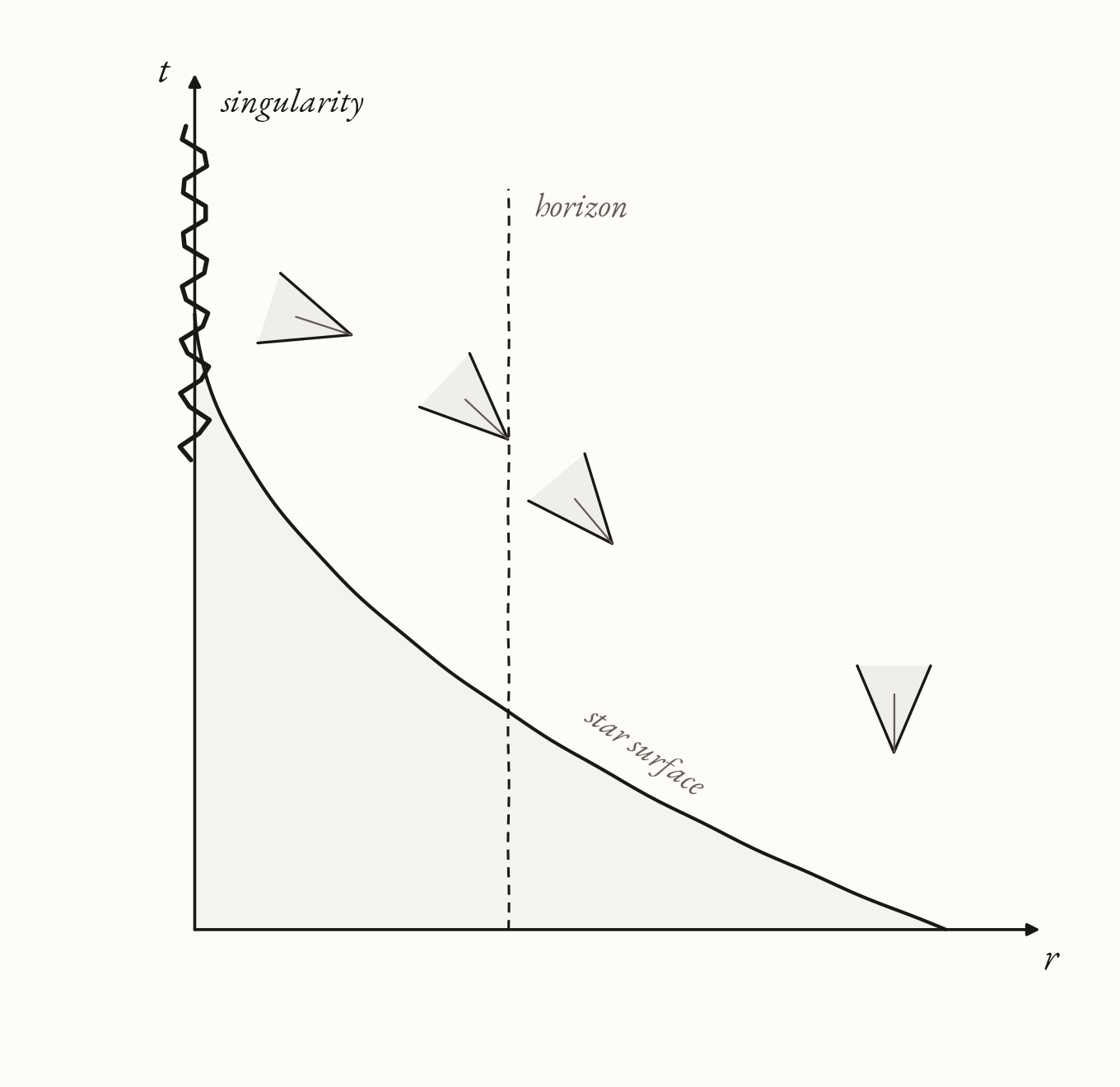
Once the surface passes the event horizon, all paths forward in time point inward. The singularity isn’t a place down there; it’s in your future, as unavoidable as next Tuesday. The star doesn’t get crushed so much as it runs out of future anywhere but the center.
GR, running solo, marches the math all the way to a point of infinite density. But the collapsing matter is quantum matter, and somewhere around the Planck scale — about 10⁻³⁵ meters, twenty orders of magnitude below a proton — GR’s smooth-geometry assumption must break, because quantum jitter should be tearing the geometry itself apart. The singularity is almost certainly not a thing in nature; it’s the boundary marker of the theory, the math waving a flag that says I’m done, send the next theory. That assessment is nearly universal among physicists — but note what layer it’s on: it’s an inference from the theories’ structure, not an observation. Nobody has seen past the flag.
What’s actually at the center? All layer three: a “Planck star” that bounces, a quantum-fuzzy region with no interior, spacetime dissolving into something pre-geometric. Pick any — there’s no data, and may never be, since the horizon hides it.
So here’s the clean takeaway: quantum mechanics catches the collapse twice (white dwarfs, neutron stars) and we can watch it win. The third round happens behind the horizon, at scales where both theories apply and contradict each other — and that’s the room nobody’s been in.
Black Holes
Alright — inside the event horizon. This is still layer one in the sense that it’s straight GR, the same math that runs your GPS; the caveat is that we’re trusting it in a place we can’t check, right up until the Planck flag.
The key is what the horizon actually is. It’s not a surface, not a membrane — falling through, you’d feel nothing, notice nothing (Einstein’s free-fall happiest-thought again: you’re weightless, coasting). What changes is the direction structure of spacetime. Outside, you can move freely in space but are dragged inexorably through time — you can pace around your kitchen, but you cannot refuse next Tuesday. Inside the horizon, the radial direction inherits that property. Decreasing radius becomes the direction you are dragged through, the way the future is. “Toward the center” stops being a place you could avoid by firing rockets and becomes a when. Firing your rockets outward doesn’t slow your fall any more than running west delays Tuesday.
This reframes the singularity completely. It’s not a dense little ball sitting at the middle that you approach — it’s a moment, the last moment, lying ahead of every worldline inside. That’s why nothing escapes: escaping would mean moving into the past. And it dissolves a classic confusion — people picture the infalling star’s matter “sitting” at the center being infinitely dense, but there’s no “sitting”; there is matter, and there is its terminal future, and the geometry between them.
Two textures worth having. First, time on the clock: for a stellar-mass hole, horizon to singularity is microseconds of your own felt time; for a supermassive one, hours — you could fall into the one at our galaxy’s center and have time to think about it. Second, the approach is not gentle: tidal forces grow without bound, stretching you radially and crushing you sideways — spaghettification — and in the more realistic (rotating, perturbed) interiors, the math suggests the end is a chaotic thrash of geometry, curvature oscillating wildly, rather than a smooth pinch. That last detail is where layer one starts shading speculative — the deep interior of a real black hole is contested terrain even classically.
And then the now-familiar move: when curvature hits Planck scale, GR’s clock runs out, and what “the final moment” actually is — a bounce, a transition, an end of time itself — is layer three, mystery all the way down. Here’s a question to sit with, since you like the ontology angle: if the singularity is a moment rather than a place, then asking “what’s at the center of a black hole” may be as malformed as asking “what’s north of the North Pole” — the question presumes a geometry that isn’t there.
The Formal Mathematics
Fair warning before we step off: this is the most steerable terrain yet. The black hole stuff had math underneath it; this is metaphysics informed by physics, where my fluency-without-friction problem is maximal. So I’ll give you the case and the strongest pushback, and you should weigh them yourself.
Here’s why “thing” is a serious candidate and not just wordplay. The demolition is already underway at layer one. Quantum field theory — the working framework beneath particle physics — quietly killed the particle decades ago: what we call an electron is an excitation of an electron field, more like a ripple in a medium than a bead. And it gets stranger, with math behind it: the number of particles present is observer-dependent. An accelerating observer detects a warm gas of particles where an inertial observer sees empty vacuum (the Unruh effect — undisputed theory, untested only because the acceleration needed is absurd). If two observers can disagree about whether particles exist, “thing” is already not doing the work you think it is.
Entanglement lands a second blow.
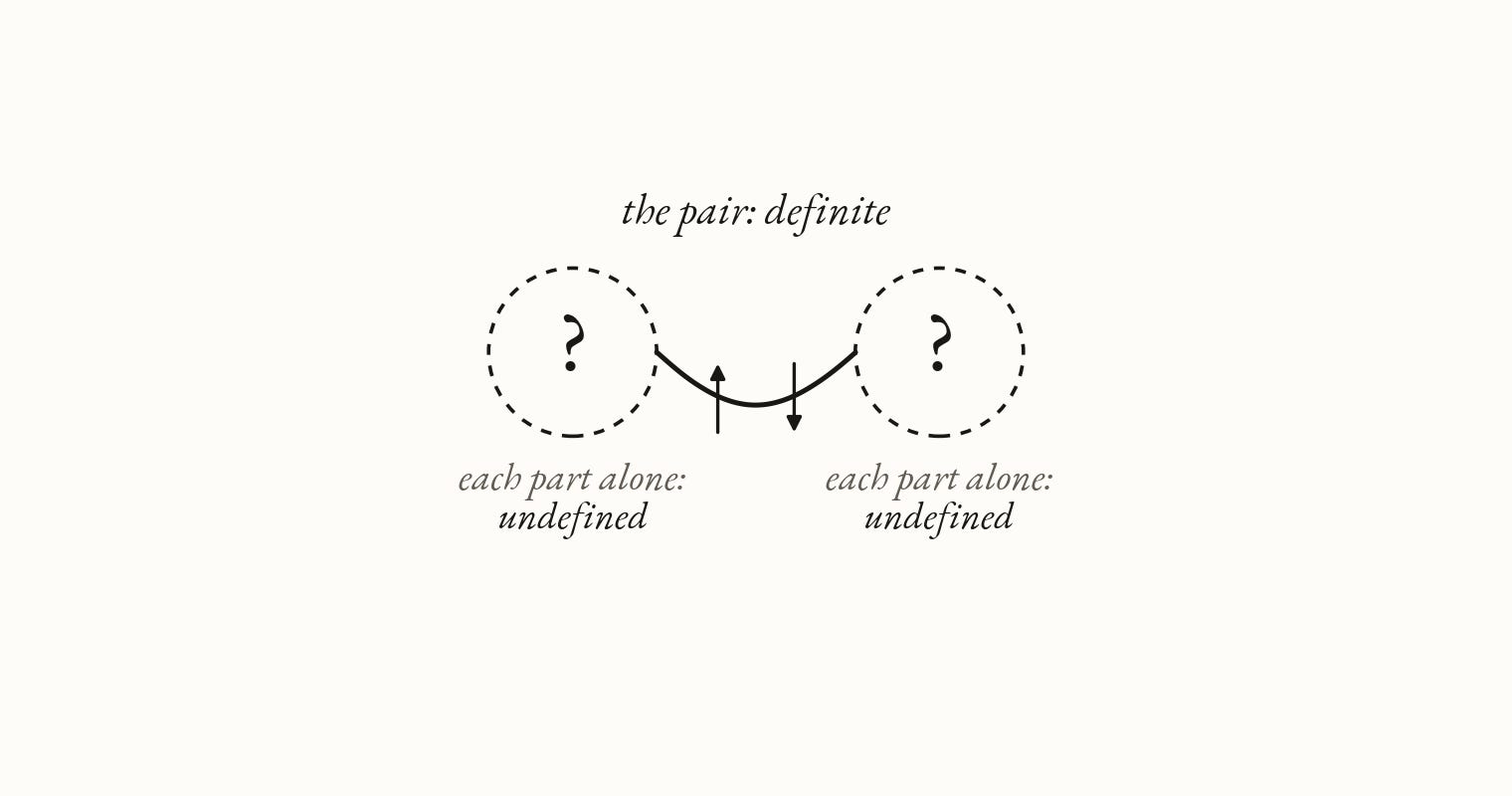
Take two entangled electrons: the pair has perfectly definite properties, while neither electron alone has any. The complete description of the parts fails to capture the whole — the information lives in the relation, not the relata. That inverts the entire Lego-brick picture of reality, where you build wholes out of fully-specified parts. It’s the experimentally confirmed part of QM (Nobel, 2022) — and it’s the load-bearing fact for the layer-three idea I mentioned earlier, that spacetime itself might be woven from entanglement. If that program is right, even location — the minimal credential of thinghood — is derivative.
So the philosophers’ version of your thread has a name: structural realism. Its sharpest argument is one you’ve basically already built across these three essays. Look at what survives each scientific revolution. Newton’s gravitational force: dead as an entity, yet his equations live inside Einstein’s as a limiting case. The luminiferous ether: dead, yet Maxwell’s wave structure carried straight through. The pattern is that the objects of physics keep getting executed while the mathematical structure keeps getting inherited. Conclusion: the structure was the real content all along, and the “things” were always interface — the cartoon our object-tracking primate brains paint over the math. Rovelli pushes a cousin of this inside QM itself: systems have properties only relative to other systems, full stop; the standalone object was never there.
Now the pushback, because it’s strong. “Relations without relata” teeters on incoherence — a relation seems to need something to relate, the way a marriage needs spouses; critics argue structural realism either smuggles objects back in or dissolves into “reality is math,” which explains nothing. There’s also a sober deflationary reading: every theory we’ve ever had posits objects of some kind — fields are things too, just unfamiliar ones — so maybe the lesson is merely that our things keep getting weirder, not that thinghood dies. And note the disanalogy with Brian’s wave and your force: those were corrected by better physics with receipts. “No things, only structure” has no receipts and may be unfalsifiable — which would make it exactly the kind of fluent-sounding non-knowledge you hedged against.
Where I honestly land: the demotion of “thing” from fundamental to emergent is well underway and has real physics behind it; the elimination of things is a metaphysical bet with no scoreboard. And notice we’ve hit the mystery floor again, from a new staircase — whether reality bottoms out in stuff, structure, or something we lack a word for is exactly as open as what’s at the singularity. Maybe more so.
The information paradox is still sitting there, and it’s the perfect capstone to this thread — because it’s where physicists were forced, by an actual calculational crisis, to start taking “reality is information/structure” seriously. It’s the receipts the philosophy is missing. Want it?
— A study session with Claude —