
May '23
Disney's provincial beginnings, stone masonry nullification, and further iterations on "California"

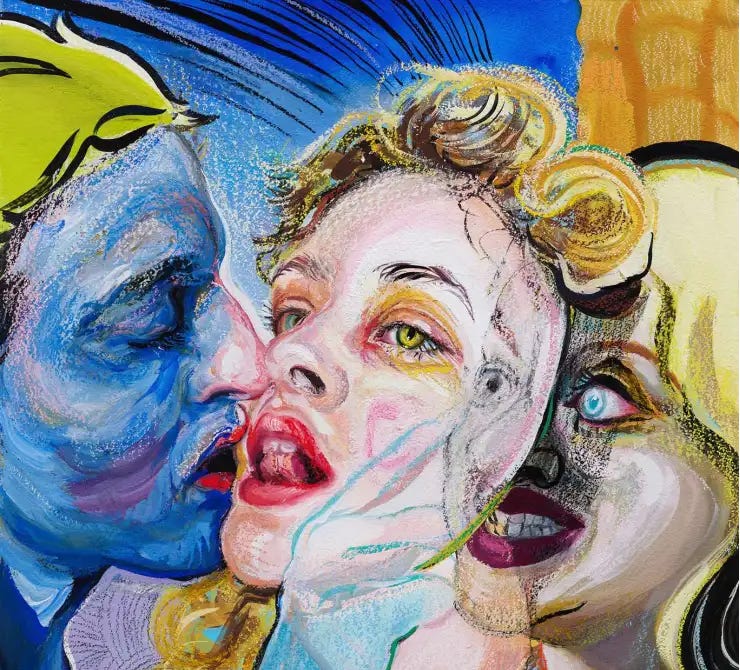
The Blue Bird I, 2019 by Natalie Frank (b. 1980)
(no - this image doesn’t have some hidden implications with my love life — lol — I just enjoy the thoughts it brings to mind :p)
The News
Walt Disney World. An Idealistic Vision.
It’s been all over the news lately, Florida + DeSantis revoking Walt Disney World’s special governmental permissions in Florida. Frankly, I don’t really have an opinion one way or another on whether this is good or bad (see valid points on both sides) but the rumblings did bring to mind the history of Disney World’s construction back in the 1960s (which I had read about a longggg time ago).
The crux of it:
Walt Disney Productions buys some 27k acres near Orlando, Florida in the 60s
All of which was done through a series of dummy corporations to avoid land speculation/rushes
Disney works with the state of Florida to get the Reedy Creek Improvement Act passed
This basically established Walt Disney World as a “county-esque” entity with all the rights/liabilities/freedoms that come with it
Disney mostly wanted this in place so that they could build/iterate without the traditional governmental/zoning red tape
Part of getting this passed involved lobbying for Disney’s vision of EPCOT
Maybe I’m the only one, but I always thought EPCOT was just another district within Walt Disney World
Didn’t realize EPCOT stands for “Experimental Prototype Community of Tomorrow” which was intended to serve as a test bed for new city-living innovations (this sounds like some 1960s American idealism/sci-fi kinda of shit)
I’m realizing now that I don’t really have a point to this Disney stuff. I just find the establishment/vision for Walt Disney World fascinating. It reminds of that movie that came out years ago called Tomorrowland.
Ideas
Stone Masonry Nullification
As several of my close friends are aware, I’m a big fan of the author Cormac McCarthy. What many may not know is that McCarthy is extremely reclusive and has only ever given a handful of interviews. One of which (supposedly forced upon him by his literary agent) took place back in El Paso, Texas in the early 90s. My favorite excerpt:
"Stacking up stone is the oldest trade there is," he says, sipping a Coke. "Not even prostitution can come close to its antiquity. It's older than anything, older than fire. And in the last 50 years, with hydraulic cement, it's vanishing. I find that rather interesting."
I don’t have much to add — given McCarthy says it so eloquently — but imagine the scope of his supposition. Stone masonry predates even the trade of Jesus Christ (carpentry) and has virtually gone extinct in the last 80 years. What does that say about humanity? Have we lost touch with the beginnings of the world?
Full interview: https://archive.nytimes.com/www.nytimes.com/books/98/05/17/specials/mccarthy-venom.html?_r=2
Ex Machina: Movie or Prophecy?
I (re)watched the movie Ex Machina recently and purposefully made a point of taking notes. For those unaware, the movie involves a tech billionaire trying to create a sentient AI (who just so happens to be played by a stunning Swedish actress). Anyway, you tell me if any of these “notes” make sense:
The magician’s assistant —> misdirection
If you leave two AI alone, do they speak English? Or their own language?
To act upon cascading ideals
When we pass the Turing Test we become Gods — having created Men
Contextual Perception
It is impossible for your brain to comprehend all the sensory data that it is being sent from your eyes. So naturally, your brain is really good at directing its computation to one thing at a time - think of this as “zooming in”. But why do we zoom in on some things and not others? For certain things the answer is obvious. You focus on the stop light when waiting for it to turn green so you know when you can release the brake. You look someone in the eye when they’re telling you a story in order to be polite. But what about when you’re walking out your front gate and zoom in on the clouds overhead? You stop, eyes raised, focusing on a single white cloud juxtaposed against the blue sky. Why? Why in that moment did your subconscious ask your eyes to stop — hold on a second — there’s something right there worth comprehending.
I recently watched “Before Sunrise” starring a young Ethan Hawke and one of his lines stuck with me on this:
Why is it that a dog, you know, sleeping in the sun, is so beautiful, you know, it is, it's beautiful, you know, but a guy standing at a bank machine, trying to take some money out, looks like a complete moron?
It feels like its a matter of context. And your subconscious is the one driving your frame of perception in every waking moment.
Suffering (in concept and in practice)
You may have come to realize a lot of my “ideas” stem from either movies or books (and I willfully acknowledge that haha). And while on that note, I saw a movie called “Tree of Life” a few weeks back starring Brad Pitt and Jessica Chastain and it was really weird. Like, entire intervals during the film where it was nothing but volcanos erupting and deep sea organisms ebbing in the flow. However, there was this common theme of “suffering” throughout the movie surrounding the Book of Job from the Bible. I’ll give some background on the eternal story first:
The Book of Job tells the story of a powerful, wealthy and genuinely upright man who loses everything through no fault of his own—his children, his health, his possessions—only to be reproached by his friends for stubbornly refusing to acknowledge his own guilt and maintaining his faith in God.
We have a man who has everything taken from him through the machinations of the world at work. All of us would hope we were as graceful as Job and take it in stride, but we all know we wouldn’t. We would question and curse the world and thereby God until we could come to grips with our immense suffering.
But Job’s story is a testament to who we could be. To what we ought to become. Maybe that’s the power of great stories?
Hollywood and Its Self Representation
There’s this idea in the book/movie Fight Club that “…we've all been raised on television to believe that one day we'd all be millionaires, and movie gods, and rock stars…” And I think this applies not only to the modern psychology of “who we should be” but also to “where we think we should be”. Generations of permeable culture has its epicenter in Hollywood California. Its in the music, movies, and advertisements we so often absorb. Naturally as a result, we find ourselves at 25 or 30 having a “quarter life crisis” and thinking if only we moved to LA that the world would right itself. That the golden land holds promises our current setting does not. And while it may be true that the weather in Cali is nominally better than most parts of the country, I think its important to acknowledge the discrepancies in cultural representation before loading up the U-Haul and “heading west”. Your setting dictates only some of your opportunities. Whether you act to afford new ones is a matter of conscious resolve.
Some Literature
I called Dallas, and one hot afternoon we drove around the Hollywood hills and talked. Dallas had long blonde hair and a sundress and she was concerned about a run in her stockings and she did not hesitate when I asked what it meant to be a movie star. “It means being known all over the world,” she said. “And bringing my family a bunch of presents on Christmas Day, you know, like carloads, and putting them by the tree. And it means happiness, and living by the ocean in a huge house.”
- Joan Didion (The White Album)