
January: Part 1 '23
Playboy, NFTs, and parking at the mall

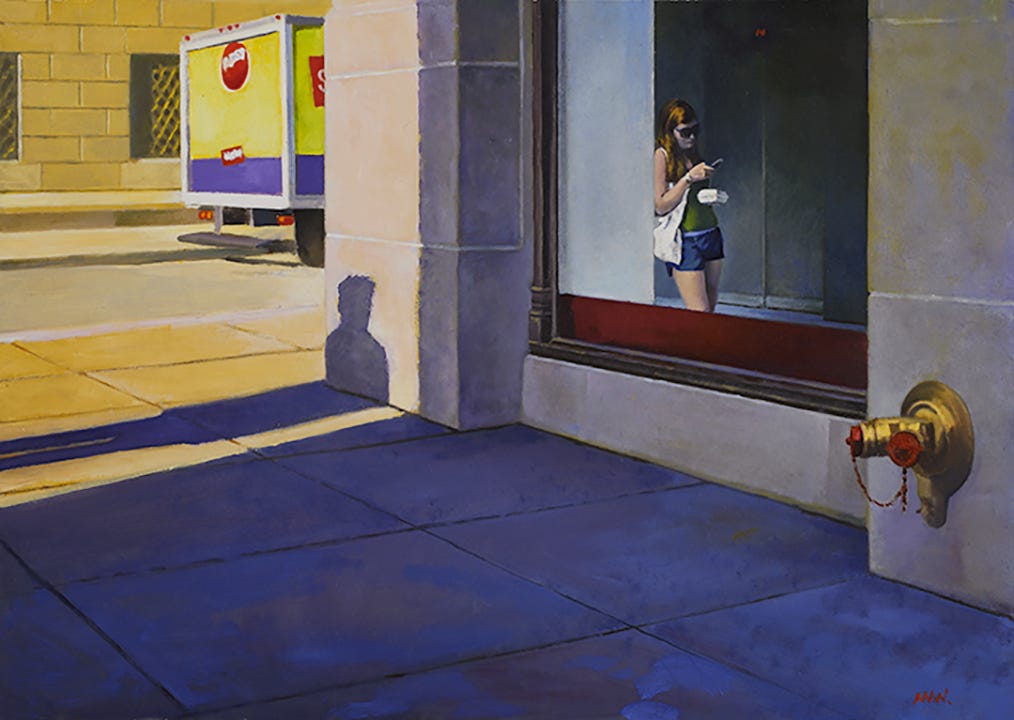
Without Even Looking by Nigel Van Wieck
The News
Wild Shit in Idaho
Apparently I've been "living under a rock" (according to a buddy) given how late I am to hear about this - but am as astounded as the rest of you. Open questions:
Suspect had no apparent motive?
Weird that cops took so long to release news/evidence/etc
Two roommates were still inside when it happened and called police 8 hours later? These roommates are "not considered suspects in the ongoing investigations"
The fact that the timeline of events is almost entirely based on phone activity is spooky from a privacy perspective
Am I the only one that think's the currently apprehended suspect looks like a cookie cutter "serial killer"? Image below for reference

Here's the link I used to catch up on this (found the timeline of events to be rather cogent): https://abcnews.go.com/US/idaho-college-murders-timeline-events/story?id=93575278
TikTok: Internal Turmoil
Picked this up from the Benedict Evans tech memo (I'd highly recommend for those wanting to keep up in tech news each week - link below) and found this bit interesting: "… company staff used location data from the app to try to see whether journalists who’d been reporting negative stories had been in the same locations as TikTok staff. That sounds… not good."
Benedict Evans Newsletter: https://www.ben-evans.com/newsletter
NFT Wash Trading
A recent research study found 45% of all NFT volume in 2022 were "shady trades". Aka, people selling to themselves in order to pump their NFT's price. I find the idea of NFT's interesting, but really don't see them going anywhere as a market.
Ideas
Instagram is Today's Playboy
From the 1950s onwards, Playboy magazine increasingly came to represent “sex” in America. The introduction of voluptuous women at the center of an advertisement stricken magazine harkened a new era for what was deemed publishable as well as mainstream. It also grew from it’s publicly assumed apish beginnings to what was seen as a tasteful gentleman’s publication responsible for printing the likes of literary giants ranging from Vladimir Nabokov to Ray Bradbury. Sex and sensuality were now subjects discussable beyond closed doors - though often dejected among the country’s more conservative sects. And not only was it just men reading Playboy, its women were found clutching copies through fits of dejectedness in an attempt to both understand as well as emulate the world’s most desirable women. This fact becomes ever more clear when we consider Playboy’s own take on the rise in popularity among women circa the early 1980s. As noted in its January 1984 edition: “Compared with our first nationwide Playmate search five years ago, this one was a colossus. In 1978, we sent five photographic teams to 28 cities and snapped Polaroids of more than 3000 women. This time, we sent seven roving photographers and their assistants to 30 U.S. cities and to one in Canada, and they were swamped by 7000 applicants — nearly twice as many, in fact, as we had expected … We wondered why … It became pretty clear after a while that we were seeing the effects of the health-and-fitness movement … an equally likely reason may be simply that PLAYBOY is now considered by more people than ever (including mothers of nice girls) a publication in a class of its own … a tasteful exception“. Women were increasingly recognizing their own beauty as well as the immense captivation the playmates had when given a platform like Playboy, and simply put, they wanted their taste.
Fast forward a few decades and the psychology hasn’t changed - only the platform. What had been previously restricted to the world’s most elite supermodels has since been opened to anyone with an iPhone 13 and Adobe Photoshop. Your content’s publication audience reachable in an instant. Glitz, glamour, and sexual intimation can be found at the tap of a finger and as far away as your sister’s Instagram profile. What used to cost thousands of dollars at the expense of a Playboy pocketbook and associated photoshoot now achievable from a walk on Sunset Boulevard in thigh-high Victoria’s Secret stockings and a Nikon D850 handled by your guy friend who took a point and shoot course at UCLA. Instagram is a cheap man’s Playboy and Howard Hefner is turning in his grave with every portrait mode selfie floated as a result of golden hour. Publius.
Generational Disposition: The Boomerang Effect
I've been reading a lot of Joan Didion lately and find her journalistic pieces not all that different from the writings of Bret Easton Ellis (author of American Psycho). This has in turn lead to some contemplation on the counter-culture of the 1960s and 70s in comparison to the nihilistic sentiment of the 1980s. It feels to me like children of the 1940s and 50s (post World War II) grew up experiencing their parents lack of fulfillment with suburban life and Sunday afternoons spent at the regional shopping center and opted instead for dope, Led Zeppelin, and "fuck the man" in the 60s. They wanted nothing to do with cookie cutter houses, cars, or ways of life. You can then follow the spiral to the 1980s where that generation saw their parents of the 60s and 70s as a generation fighting for change and expectedly turned to "what's the point?" which we see crop up socially as a lack of spirit, interests, and general dissidence from reality. I haven't thought deeply enough about our current society and the generation of millennials in this sort of contrast yet, but there seems an intuitive (and rather obvious) ping-pong effect that occurs between generations and it doesn't tend to restructure itself in the inception of new core values — rather, it just erodes existing.
Parking at the Mall
I read recently that shopping malls have a sort of “playbook” that they follow when both designing and launching a new one. For one, they will anchor “major” outlets such as Macy’s, JP Penney, etc on either end of the mall and place smaller shops in-between in order to increase exposure as folks commute between major outlets. Another involves painting the lines in the parking lot such that parking spots are much bigger than normal when the mall is first launched. This is done so that it takes less cars to give the mall a “busy” or “packed” look - generating excitement and fervor. Months (or even years) after launch when the mall has matured to a staple in the community, they will then repaint the lines to optimize for maximal parking spots.
I mean — sure — these things make complete sense. But I’ve never considered either one of these things in my life till now and it intrigues me that there is a onboarding packet out there somewhere titled “Building the Mall: Your How-To Guide”.
Some Literature
Haven't fully conceptualized this section yet - but want to encapsulate some interesting quotes I found from recent readings and maybe some short book reviews.
Book Review: Stella Maris by Cormac McCarthy

After reading all McCarthy’s novels (with the exception being his plays) I’d say this has to be his most inaccessible work. Lots of discussion on very high level mathematics and it’s conjunction with our interpretation of the world. This was like reading a McCarthy brain dump. There’s super interesting tidbits in here ranging from the history of violins to the way whales time their breathing - and it’s semi-evident to me what McCarthy was advocating as a theme - I just think it could have been more appropriately edited (the last 30 pages and the history of the Poincaré/Riemann/etc could have been excluded and the novel would have rounded out a lot better - but that’s just me). 4 out of 5 because I’m stacking this against his other incredible works.
Also, I’d like to add that I think McCarthy is a genius. And that’s coming from someone who uses that word very sparingly.