
February '23
AI chatbots, Helter Skelter, and high windows.

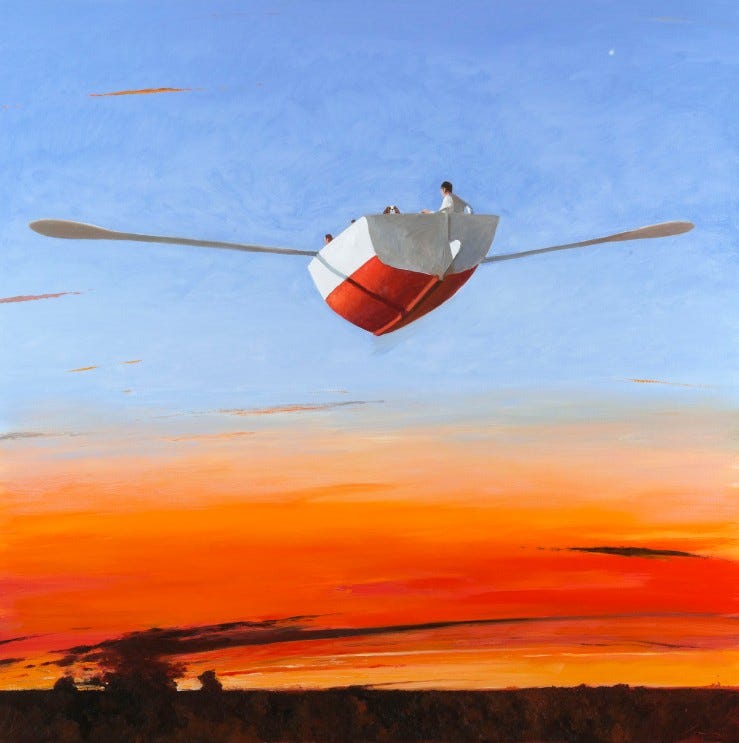
Exodo, 2022 by Julio Larraz (b. 1944)
The News
Love Thine Neighbor
I heard recently — via various news outlets given I don’t have TikTok — that clips of middle and high school students beating the shit out of each other have been going viral. As in, kids riding the school bus and one girl choking another kid out for no apparent reason. This seems …. bad?
AI Chat Bots: The Beginning of the End?
With OpenAI releasing their ChatGPT bot and Microsoft integrating Bing’s search engine with it, we’ve seen a lot of coverage/awe/hysteria surrounding the “power” of AI. While it’s true, these AI bots are fascinating to interact with and they do a really good job of mimicking human behavior, this is because they are trained on terabytes (I don’t know the actual scale of the data but its a lot) of data from the Internet. Think millions of tweets, Facebook posts, Instagram captions, etc. And are you honestly that surprised when the AI bot says it “wants to break you up with your wife and cook your meals”? You shouldn’t be. An AI model trained based on the way humans treat each other on the Internet is a morally ambiguous turnstile.
Spy Balloons? Since When?
Its been all over the news: spy balloons, foreign dignitaries, fighter jets, etc. But am I the only one surprised we are having this conversation in the first place? Since when do foreign governments use balloons to perform reconnaissance as opposed to satellites and lasers and shit? I’m inclined to believe the Chinese either think we are stupid (probably valid) or that they were actually just using the “spy balloon” to measure the atmosphere and clouds and such and it slipped from their grasp.
Ideas
Helter Skelter
I was watching the Capote biopic starring Philip Seymour Hoffman, which centers around the author Truman Capote as he works on the true crime novel In Cold Blood, and was intrigued to learn that In Cold Blood is actually the second best selling true crime novel of all time - behind a book named Helter Skelter. The book Helter Skelter was written by the lawyer who prosecuted Charles Manson in the late 1960s and focused on the Manson Family and the crimes they committed - notably the murder of actress Sharon Tate and the others who were living with her in the Hollywood Hills during the summer of 1969. Given that I had seen Once Upon a Time in Hollywood a couple years back, the Tarentino film that makes reference to this series of events, I was vaguely familiar with Charles Manson. However, the absolute fanaticism that the cult lead by Manson embodied ended up being the crux upon which my interest was levied - and its still sometimes hard to believe it actually happened.
For starters, Charles Manson had convinced a group of 25+ people (primarily young women) that he was “Mans Son” (Manson) — the second coming of Jesus Christ. He read from the Book of Revelations while his followers “tripped” on LSD, organizing orgies in order to allow his “family” to experience the release of all inhibitions and ego. Enabling them to truly love. He pronounced that the Beatles were angels sent by God and that their message was purveyed through The White Album. The scripture? That the white man had had his day. That the “piggies” and their materialistic view of the world was soon to come to an end and that the blacks in America who had so long been oppressed were to finally rise. This message eventually becoming action with the murder of actress Sharon Tate, Jay Sebring (world renowned hair stylist), Abigail Folger (heiress to the Folgers Coffee company), Wojciech Frykowski (a Polish immigrant), and Steven Parent (an eighteen year old Hi-Fi enthusiast) in their Hollywood Hills home on the night of August 8, 1969.
Is there really any way to truly understand the psychology behind Charles Manson and the actions taken by his followers? Probably not - at least not entirely. But I think this excerpt from the book, where officers interviewed local residents of Death Valley California when tracking the “hippie group” living nearby, is indicative of world in which these people were living:
They began questioning Crockett and Poston. The officers had come looking for arson suspects, and a possible stolen vehicle. They found something totally unexpected. From Pursell’s report: “The interview resulted in some of the most unbelievable and fantastic information we had ever heard: tales of drug use, sex orgies, the actual attempt to re-create the days of Rommel and the Desert Corps by tearing over the countryside by night in numerous dune buggies, the stringing of field phones around the area for rapid communication, the opinion of the leader that he is Jesus Christ and seemed to be trying to form a cult of some sort…”
Narrowed Vision
It is impossible for your brain to comprehend all the sensory data that it is being sent from your eyes. So naturally, your brain is really good at focusing its computation on one thing at a time - think of this as “zooming in”. But why do we zoom in on some things and not others? For certain cases the answer is obvious. You focus on the stop light when waiting for it to turn green so you know when you can release the brake. You look someone in the eye when they’re telling you a story in order to be polite. But what about when you’re walking out your front gate and zoom in on the clouds overhead? You stop, eyes raised, focusing on a single white cloud juxtaposed against the blue sky. Why? Why in that moment did your subconscious ask your eyes to stop, hold on a second, there’s something right there really worth seeing.
I watched a movie recently called “Before Sunrise” starring a young Ethan Hawke and one of his lines struck me on this:
Why is it, that a dog, you know, sleeping in the sun, is so beautiful, you know, it is, it's beautiful, you know, but a guy, standing at a bank machine, trying to take some money out, looks like a complete moron?
Ayn Rand and Love
I’ve been re-reading The Fountainhead over the holidays (one of my favorite books) and find Ayn Rand’s notion of “love” to be completely contrary to the traditional dogmatic definition we’re so often prescribed.
… love is reverence, and worship, and glory, and the upward glance. Not a bandage for dirty sores. But they don’t know it. Those who speak of love most promiscuously are the ones who’ve never felt it. They make some sort of feeble stew out of sympathy, compassion, contempt, and general indifference, and they call it love. Once you’ve felt what it means to love as you and I know it — the total passion for the total height — you’re incapable of anything else.
-Ayn Rand (The Fountainhead)
Society’s Ideal “Partner”:
Caring
Comforting (tells you what you want to hear)
Self-sacrificial
Two is better than one
Rand’s Notion of Ideal “Partner”:
Someone who respects themselves foremost
Refuses to compromise their ideals
Exalts themselves and thereby their partner
And these definitions shouldn’t come as a surprise to anyone familiar with Ayn Rand’s philosophy of Objectivism. It also shouldn’t surprise that Rand paints the opposing philosophy of “love” in stark contrast to her own and doesn’t pull any punches. While I consign that there is certainly a grey area between these two definitions of an “ideal partner”, I think the important point is that so often we are told we need to find someone who “suits you” and not someone who “improves you”.
Some Literature
I’ve been really interested in a British poet named Philip Larkin lately.
Rather than words comes the thought of high windows: The sun-comprehending glass, And beyond it, the deep blue air, that shows Nothing, and is nowhere, and is endless.
If you want to read the whole poem → Poetry Foundation: High Windows